Types of Façade Insulation in Switzerland: ETICS, Ventilated Façades and How to Choose
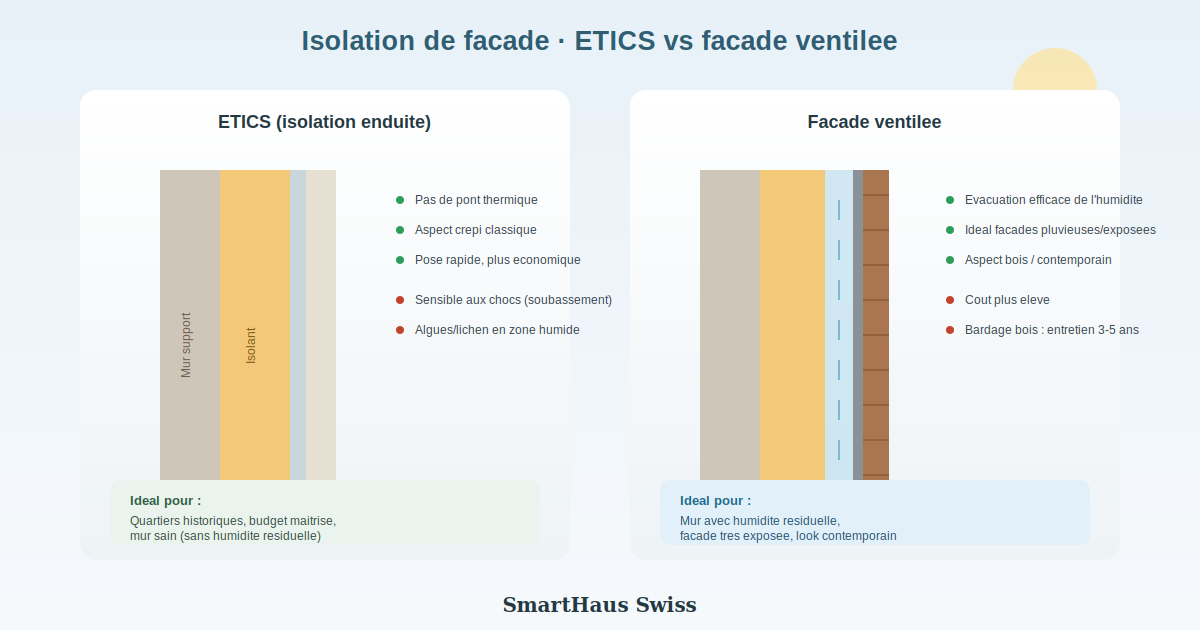
Two major families of external insulation systems
In Switzerland, external façade insulation splits into two fundamentally different families: rendered insulation (often called ETICS internationally) and the ventilated façade (isolation ventilée). Each family handles moisture according to its own logic, and that's precisely what determines where each system is appropriate.
The ETICS system: insulation under render
ETICS (External Thermal Insulation Composite System) is the classic and most widespread solution. It consists of several layers: the supporting wall, an insulation board, a reinforcing layer with a fibreglass mesh, and a finishing decorative render.
The main advantage of ETICS is eliminating thermal bridges, since the insulation covers the wall continuously, without gaps. It gives a classic, familiar rendered façade look, which makes architectural integration into existing surroundings easier — particularly important in the historic districts of Geneva and Lausanne, where a building's appearance needs to harmonise with its environment.
The system has weak points too. ETICS has low tolerance to mechanical impact at the base of the façade (at plinth level) and some sensitivity to algae and lichen growth in humid environments, which can require periodic water-repellent treatment.
The ventilated façade: managing moisture through an air gap
The ventilated façade works differently: insulation is fixed to the wall, and then an outer cladding (wood, fibre cement, composite, ceramic or zinc) is fitted over it, on a timber or metal frame set away from the wall, creating a ventilated air gap.
The key difference from ETICS is precisely this ventilated air gap between the insulation and the cladding, which helps evacuate moisture. Thanks to this, the technique is particularly well suited to rainy regions and façades heavily exposed to weather, as well as to walls that already have residual moisture issues.
Wood cladding is valued for its natural, warm look, but it needs regular maintenance — a stain or oil treatment every 3 to 5 years. Fibre-cement or composite cladding is a good compromise: an aesthetic close to wood, without that maintenance demand.
How to choose between the two systems
The choice between ETICS and a ventilated façade depends on budget, the desired look and the building's technical constraints. Both offer comparable thermal performance, but the logic of application differs.
ETICS is generally more economical and quicker to install, which makes it the most common solution on the market. A ventilated façade is preferable for façades heavily exposed to rain, or when the supporting wall already has residual moisture issues — the air gap then becomes a functional solution, not just an aesthetic one.
An important point to plan for: if the supporting wall is damp or has rising damp, an insulation system should not be fitted without prior treatment — the moisture would end up trapped inside the masonry and accelerate its deterioration. A moisture diagnosis of the wall is therefore a mandatory first step before choosing any system.
Insulation materials: what to know
The choice of insulation material determines both the required thickness and the final budget: the lower a material's lambda (thermal conductivity), the better it insulates at the same thickness.
Expanded polystyrene (EPS), including the graphite-enhanced variant, remains the most widely used material thanks to its low cost and ease of installation, but it's sensitive to UV and has limited mechanical strength. Rock wool offers an excellent performance-to-price ratio, and it's also non-combustible (class A1) with good acoustic performance — in Switzerland, where the well-known rock wool brand Flumroc is manufactured, this material is especially common in both ETICS and ventilated façades. Wood fibre board is chosen where summer comfort and the material's environmental credentials are the priority.
The Swiss context: subsidies and staying in your home during the work
External insulation in Switzerland offers two practical advantages that are often underestimated. First, external thermal insulation is precisely the category that receives priority subsidies under the Buildings Programme — it's the best-subsidised category of energy-related work. Second, all the work is carried out from outside the building, so the house or apartment remains fully liveable throughout the project — no one needs to move out or live amid construction dust indoors.
Another practical benefit: the façade gets a visual refresh at the same time, since the render or cladding is installed as part of the same operation, at no major extra cost — you get both energy efficiency and a renewed exterior look together.
How SmartHaus Swiss helps you choose an insulation system
The right choice of system doesn't start with a materials catalogue, but with a diagnosis of your specific building: the condition of the wall, moisture levels, architectural constraints and the requirements of local regulations in your district of Geneva or Lausanne. We choose between ETICS and a ventilated façade based on these factors, not on what's "easiest to sell." We also factor in subsidy possibilities at the planning stage, so the chosen solution and the order of work maximise the support available.
Frequently asked questions
Which system is cheaper — ETICS or a ventilated façade?
Generally, ETICS is more economical and quicker to install. A ventilated façade is usually more expensive, but is justified where moisture evacuation or a specific cladding look is a priority.
Can you insulate a façade if the wall is already damp?
No, not without prior treatment. Moisture in the supporting wall needs to be addressed before any insulation system is fitted, or the moisture will stay trapped inside the wall.
Which insulation is better — polystyrene or rock wool?
Polystyrene is cheaper and lighter; rock wool is non-combustible and performs better acoustically. The choice depends on priorities: budget, fire safety, sound insulation.
Does wood cladding on a ventilated façade need maintenance?
Yes, it needs a stain or oil treatment every 3 to 5 years. Fibre cement or composite are lower-maintenance alternatives with a similar look.
Can you live in the apartment while the façade is being insulated?
Yes, all external insulation work is carried out from outside the building and doesn't disrupt everyday life indoors.
The technical characteristics of the systems are described in general terms; the specific choice of materials, insulation thickness and system depends on the building's condition, architectural constraints and your commune's regulations. The exact solution and quote are determined after inspecting the property.