Heat Pump or Gas Boiler: Which Is More Cost-Effective in Switzerland in 2026
In brief: efficiency versus fuel cost
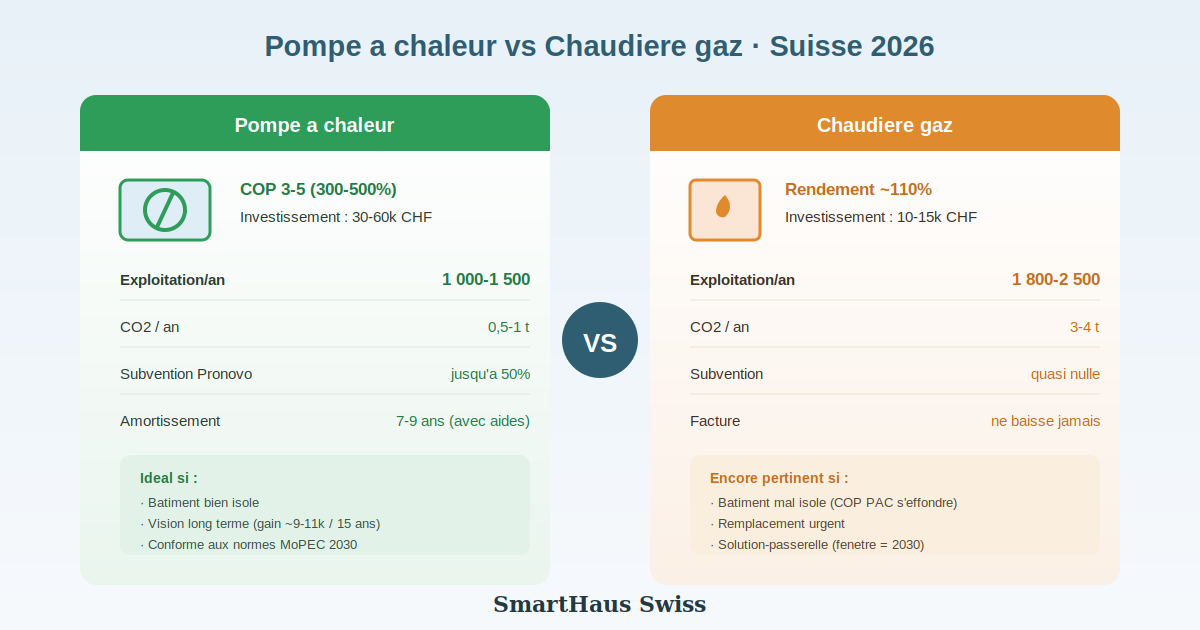
The key difference is physics. A gas boiler, even the most efficient condensing type, tops out at around 110% efficiency thanks to recovering heat from the flue gases, whereas the heat pump plays in another league. Thanks to its coefficient of performance (COP), an air-to-water heat pump returns between 3 and 5 kWh of heat per 1 kWh of electricity consumed — an "efficiency" of 300 to 500%. HVAC IntelligenceHVAC Intelligence
Put simply: a gas boiler burns fuel, while a heat pump pumps free heat from the air, spending electricity only on that transfer. Hence the gap in bills.
The money: upfront investment versus running savings
This is where the central trade-off lies. According to Swiss data: the choice comes down to investing 20,000–35,000 CHF upfront to save 600–800 CHF each year, or paying 10,000–15,000 CHF now and living with an annual bill of 1,800–2,500 CHF that will never drop. Oclaire SA
Let's break down running costs. A modern condensing gas boiler for a 100–150 m² Vaud house costs 10,000–15,000 CHF installed, and running it comes to 1,800–2,500 CHF per year depending on insulation. The heat pump is more expensive to install: according to professionals, replacing an old boiler with a heat pump costs between 30,000 and 60,000 CHF depending on the pump type and the time to dismantle the old system, but with a COP of around 4.5, annual running costs come to 1,000–1,500 CHF versus 1,800–2,500 CHF for gas. Oclaire SA + 2
Payback: how many years for the pump to recoup the difference
Subsidies play a decisive role here. With Pronovo subsidies (up to 50% of the cost), the difference is recouped in 7–9 years, and the net result over 15 years reaches 9,000–11,000 CHF after deducting the aid. Over the long term, the picture is even clearer: as a rule, a heat pump is amortised in about fifteen years; owners of single-family homes can save around 10,000 CHF over 20 years with an air-to-water pump, and more by adding photovoltaics. Oclaire SABcbe
Another advantage of the pump: less maintenance. Unlike oil boilers, there's no need to regularly clean the chimney or service the tank, and self-produced solar electricity keeps costs stable, whereas gas and oil remain subject to market fluctuations. Bcbe
When a gas boiler still makes sense
Here, honesty matters more than slogans. Most Swiss guides recommend the heat pump without qualification — and that's a mistake. For certain poorly insulated Vaud buildings, connected to the grid and with an urgent replacement need, gas remains the only realistic option in 2026. Oclaire SA
The reason comes down to insulation. The gap in running costs becomes negligible if the thermal envelope leaks like a sieve: a gas boiler in an uninsulated 1980s villa consumes 2,500 CHF per year, but an air-to-water heat pump in the same building climbs to 2,000 CHF because the COP collapses when heat demand spikes. That's why the better insulated a home is, the more high-efficiency solutions (heat pumps) win out, because the system operates in favourable conditions — lower supply temperatures and more stable cycles. Oclaire SA
There's also a compromise. Combining a heat pump with an existing gas boiler avoids replacing the radiators (a saving of 3,000–8,000 CHF): the pump covers 80% of the year, and gas takes over below −5°C — the ideal solution for complex renovations without optimal insulation. Oclaire SA
The regulatory factor: the window for gas is closing
The economics can't be read without the law. The MoPEC standards push towards phasing out fossil fuels by 2030, and from 2030 the canton of Vaud requires a 50% reduction in CO₂ emissions, which makes any gas replacement after 2026 risky. There's also a market dimension: gas (3–4 tonnes of CO₂ per year) becomes a regulatory liability for developers and property managers, while the heat pump (0.5–1 tonne with decarbonised Swiss electricity) wins in tenders. Oclaire SAOclaire SA
How to decide in your case: three questions in order
Before choosing, professionals advise checking three things, in this precise order. First the presence of the gas network in your street, then the current insulation level (which determines the pump's efficiency), then calculate the net cost after Pronovo subsidies. A telling result: 8 out of 10 cases switch to the heat pump once these figures are laid out. Oclaire SAOclaire SA
How SmartHaus Swiss helps you choose
The right order matters here more than the equipment itself. If the house is poorly insulated, it's better to insulate the façade first — the heat pump then needs less output and works better. We carry out both façade insulation and heat-pump installation, which lets us assess your situation as a whole rather than sell a single box. We help you understand what's advantageous for your specific building and plan the work in the right order — subsidies and standards included. The exact calculation is always made after inspecting the property.
Frequently asked questions
Is a heat pump always more cost-effective than gas?
No. In a well-insulated house, almost always yes, but in a poorly insulated building its efficiency drops and the cost gap narrows. Insulation first, then the pump.
How long does a heat pump take to pay off?
With subsidies, roughly 7–9 years; full amortisation usually occurs in about fifteen years.
Do you need to replace the radiators?
Not necessarily. A hybrid solution (pump + existing gas boiler) avoids replacing radiators. The exact answer depends on your system.
Does a heat pump work in freezing weather?
Yes. Modern pumps hold down to −15°C, though the COP drops in very cold weather.
Should you still install a gas boiler in 2026?
In certain cases (poor insulation, urgent replacement, an area with no alternative), yes, as a bridging solution. But the regulatory window for gas is closing by 2030.
The figures in this article are 2026 market benchmarks from Swiss sources; they depend on the canton, insulation, energy prices and configuration. The exact calculation is made after assessing the property, and subsidy amounts should be checked on the official portals before starting work.