Hiring Separate Tradespeople or One Turnkey Company: What Actually Differs in Switzerland
What changes legally with multiple contractors
In Switzerland, the relationship between client and contractor is governed by the Code of Obligations (CO), and in construction practice, the SIA 118 standard — the general conditions for the execution of construction work, drawn up by the Swiss Society of Engineers and Architects — is used almost universally. An important detail: SIA 118 is not a law in itself — it only applies when the parties have expressly incorporated it into the contract. That's why checking whether your contract with the electrician, plumber and painter references SIA 118 is the first thing worth doing.
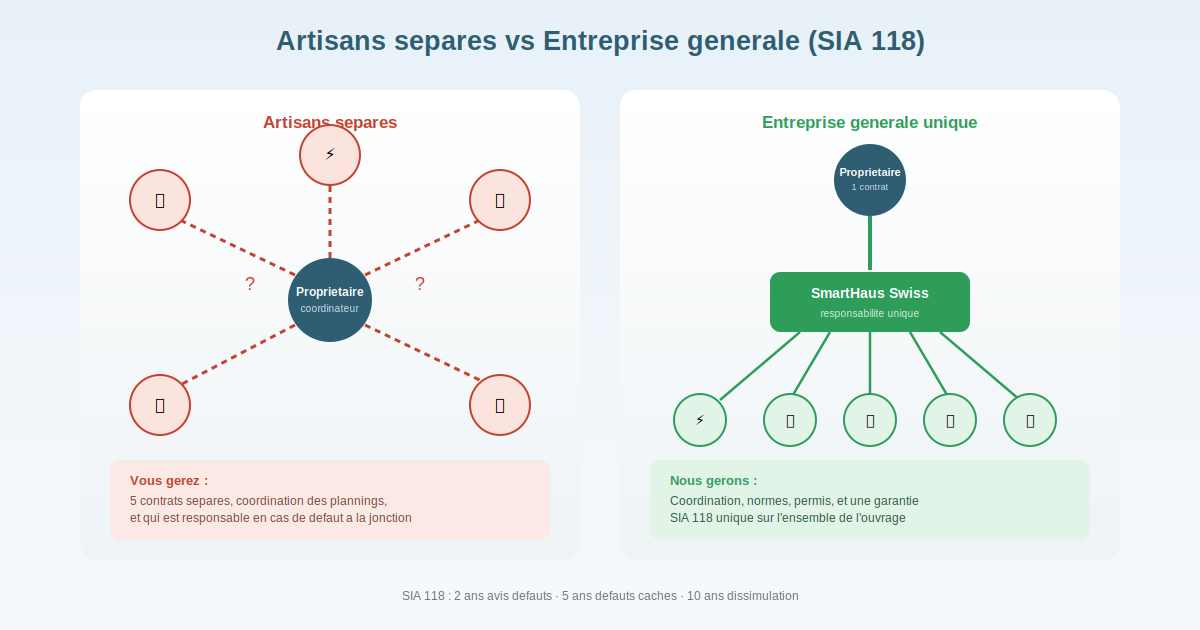
When you hire tradespeople directly, you end up not with one contract, but with several separate construction contracts — with the electrician, the plumber, the tiler, and so on. Legally, each one is only liable for their own portion of the work. If a leak occurs at the junction between plumbing and finishing, you'll have to work out yourself who's responsible — and the different tradespeople will often point at each other.
How a general contractor's liability works
When you work with a single company as the general contractor, the picture is different. The general contractor takes on regulatory responsibility for the project as a whole: checking the necessary permits, submitting applications for them where required, and ensuring every trade involved complies with the applicable standards. The general contractor is also liable for work carried out by subcontractors with whom they've entered into a contract — so you always have one accountable party in front of you, not a chain of separate tradespeople.
The practical effect is simple: the owner signs a single contract, which considerably simplifies the legal management of the project. You don't need to act as go-between among five different contractors if something goes wrong — you deal with one contractor, and if the problem originates with a subcontractor, sorting it out with them becomes that contractor's job, not yours.
Warranty periods: what you're actually entitled to under SIA 118
Here are concrete figures worth knowing for any client, regardless of the hiring model chosen. Under SIA 118, the contractor is obliged to deliver work free of defects and is liable for them regardless of fault on their part. The client must notify the contractor of defects within 2 years of handover, unless otherwise agreed — during that period, defects can be reported at any time. For hidden defects discovered later, the limitation period for a claim is 5 years from handover. And if the contractor intentionally concealed a defect, that period extends to 10 years.
There's also a practical lever of pressure on the contractor: the client generally has the right to withhold a retention, often 10% of the contract sum, until defects identified at handover are fully resolved. If the contractor refuses to fix faulty work, the client must set a reasonable deadline in writing for the correction; if the contractor fails to meet that deadline, the client is entitled to have a third party carry out the correction and bill the cost to the defaulting contractor.
The difference in practice: where liability breaks down with separate contractors
The five-year limitation period for hidden defects applies both to the general contractor and to each individual trade involved in the project. Formally, you retain the right to demand a defect be fixed by a specific tradesperson if you hired them directly. But in practice, when the defect sits at the junction between two areas of responsibility — for example, a water leak that damaged freshly applied plaster — proving whose fault it is and getting separate contractors to fix it is considerably harder than raising a claim with a single general contractor who's accountable for the whole result.
Another point often overlooked: SIA 118 applies not only to large general-contracting projects but also to small jobs carried out by individual tradespeople — provided it's expressly stated in the offer or quote you signed. This means that even when hiring tradespeople directly, it's worth explicitly requiring SIA 118 terms to be included in each separate contract — otherwise you end up in a weaker legal position than you could have.
What to choose: a question of liability, not just price
Hiring separate tradespeople directly may look cheaper on paper, since you pay each specialist directly, without a coordination markup. But that saving shifts the project-management function onto you: coordinating different crews' schedules, controlling the quality of the junctions between stages, and, if a problem arises, working out yourself which contractor is liable.
A single turnkey contractor takes on that burden, and the cost difference is, in essence, the price of a single point of accountability and the legal protection SIA 118 provides across the whole property, rather than its separate parts.
How SmartHaus Swiss works
We act as a single, accountable general contractor: one contract, one point of contact, one guarantee covering the entire scope of work, including work technically carried out by different specialists within our team. We explicitly incorporate SIA 118 conditions into our contracts, giving you clearly defined warranty periods and a clear mechanism should anything need correcting. If a defect arises at the junction, say, between plumbing and finishing, you don't need to work out whose area of responsibility it is — that's our job.
Frequently asked questions
Is it cheaper to hire tradespeople directly?
On paper, sometimes yes, but that saving is offset by the fact that you take on the coordination and the sorting-out if a problem arises at the junction between different contractors' work.
What is the SIA 118 standard, and is it mandatory?
It's the general conditions for construction contracts, drawn up by the Swiss society of engineers and architects. It only applies if expressly stated in your contract — worth checking before signing any quote.
How long does a renovation warranty last in Switzerland?
Under SIA 118, you have 2 years to report defects after handover, and the limitation period for a claim on hidden defects is 5 years; if a defect was intentionally concealed, that extends to 10 years.
What if the contractor refuses to fix faulty work?
You need to set a reasonable deadline in writing for the correction. If they fail to meet it, you're entitled to have a third party carry out the fix and bill the cost to the original contractor.
Who's liable if it was a subcontractor of the general contractor who did the work?
The general contractor is also liable for their subcontractors' work — you don't need to deal directly with each of them.
The information in this article is of a general, informational nature and doesn't replace legal advice. Exact warranty and liability terms are always set by the specific contract; when signing a contract, it's advisable to check whether SIA 118 is included and, where needed, consult a lawyer.