The CECB: Switzerland's Building Energy Certificate — What It Is, When It's Required and How Long It Lasts
What the CECB is
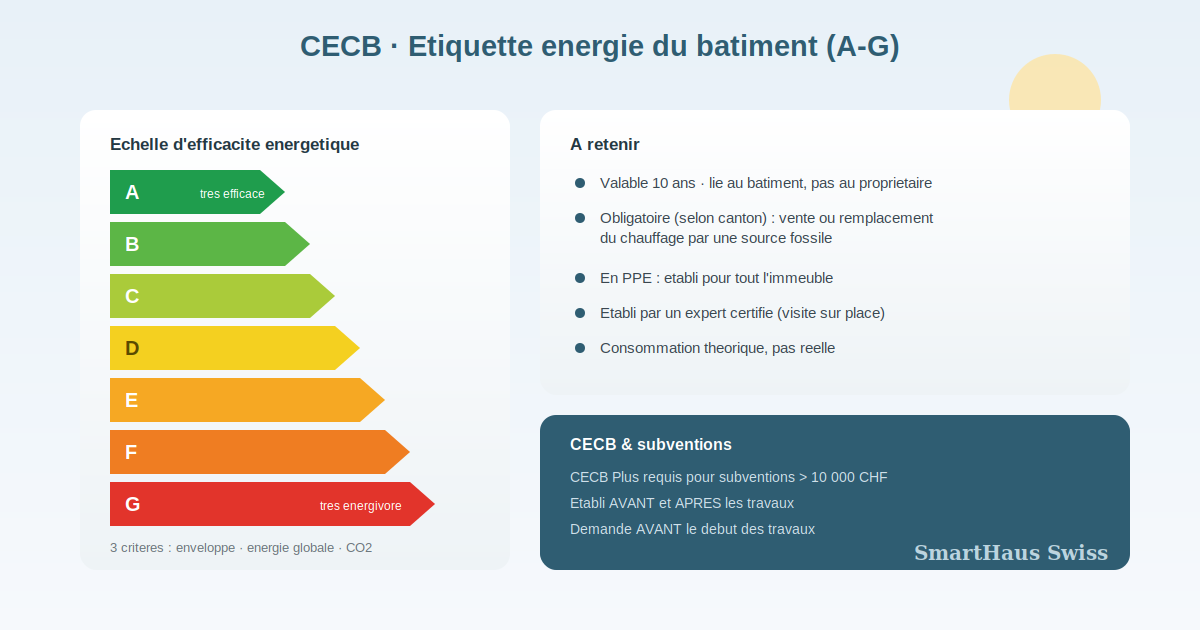
The CECB (Certificat énergétique cantonal des bâtiments) is a building's official energy certificate, uniform across Switzerland. It's the cantons' official energy label — a document showing the quality of the building's envelope, its overall energy balance and its direct CO₂ emissions, on a seven-class scale from A to G. The certificate is issued by a certified energy-efficiency expert, who personally visits the building for the assessment. CecbAutourdelamaison
A point often misunderstood: the CECB calculates a standardised theoretical consumption, not your actual energy use. So it assesses the building itself (insulation, systems), not the occupants' habits. RealAdvisor
What the certificate assesses
Since 2023, the CECB assesses three characteristics in the logic of the energy label: the efficiency of the building envelope, overall energy efficiency, and the direct CO₂ emissions the building produces on site from burning fossil fuels for heating and hot water. Cecb
The efficiency of the envelope is the most important parameter for assessing a building's heating needs. It includes the thermal insulation of the external walls, roof and floors, as well as window quality; thermal bridges (such as balconies) and the building's shape are also taken into account. Logically, using renewable energy and/or a heat pump leads to a better rating. Autourdelamaison + 2
The four forms of CECB
There are several variants for different needs. The standard CECB is a four-page document showing the building's energy class (A–G); it's valid for 10 years and is sufficient for most routine procedures: sale, rental, financing. The CECB Plus additionally includes an advisory report with up to three costed renovation variants, an estimate of accessible subsidies and prioritised recommendations; its validity is also 10 years. Separately, there's the CECB New Building, mandatory for any new construction; it sets the target energy-efficiency values and can be converted into a standard CECB after three years of operation. Finally, the online CECB Diagno tool allows an initial self-assessment. RealAdvisor + 2
Practical tip: if you're considering work, go straight for the CECB Plus — it opens the door to maximum subsidies and saves you ordering two separate documents. RealAdvisor
When the CECB is mandatory
An important subtlety: the rules vary by canton. The CECB is in principle optional, but some cantons require it on a property transfer or when replacing a heating system. Cecb
In the canton of Vaud, for example, the rules are clear. Drawing up a CECB is mandatory when selling an existing residential building, and when replacing a heating system with a new one powered by a non-renewable source (oil, gas, coal). The CECB must be drawn up before replacing the heating or before the sale, because its purpose is to assess the energy state of the building's envelope and systems. Canton de VaudCanton de Vaud
A special case: condominium apartments. If your property is an apartment in a PPE, the CECB to be provided must be drawn up for the whole building, not just the lot being sold. In practice, the entire building is assessed, and the cost falls to the co-owners. Neho
Worth remembering: obtaining a CECB does not entail any obligation to carry out energy renovation of the building. The certificate informs but doesn't compel renovation. Acheteur
Validity and reuse
The CECB belongs to a building, not an owner, and is valid for 10 years. A building that already has a CECB can be sold without re-certification during its validity (10 years), provided the heating system and envelope haven't been modified since it was drawn up. If the heating or insulation has changed, an updated certificate will be required. Groupe-eCanton de Vaud
CECB and subsidies: the key link
For an owner planning work, this is the most important section. This certificate is required to obtain subsidies over 10,000 CHF under the Buildings Programme. In an energy renovation, the CECB is drawn up before and after the work, and the subsidy amount is calculated based on the area and the progress achieved between the two energy-label assessments. AutourdelamaisonFreiburg
And again the critical rule about order: subsidies must be requested before the work begins; a CECB drawn up after the fact no longer gives access to them. The subsidy application is to be made by the owner, before the expert's involvement. RealAdvisorGroupe-e
A good energy label also means property value
Beyond the obligation, the CECB has a market dimension. A well-rated building sells faster and can justify a higher price, while an energy-hungry property becomes a downward negotiation argument; some banks offer preferential mortgage terms for high-performing properties. That said, the CECB in itself doesn't raise the sale price — it's the real energy quality it reflects that counts. RealAdvisorGroupe-e
How SmartHaus Swiss fits into this context
The CECB certificate itself is issued by an independent certified expert — which is what guarantees its objectivity. Our role is in the work that improves your energy class: façade insulation, replacing heating with a heat pump, ventilation. It's precisely this work that moves the building up the A–G scale and, done in the right order and before the application is submitted, opens access to subsidies. We help you plan the sequence so that the CECB Plus, the work and the support application are consistent with one another.
Frequently asked questions
Is a CECB mandatory to sell an apartment?
It depends on the canton. In several cantons, such as Vaud, it's mandatory when selling a residential building. Check your canton's rules.
How long is a CECB valid?
10 years, provided the heating and envelope haven't changed since it was drawn up.
What's the difference between CECB and CECB Plus?
The standard CECB is the building's energy label. The CECB Plus adds renovation variants, a subsidy estimate and a prioritisation of the work.
Can a tenant order a CECB?
No, only the owner can undertake this.
Do you need a CECB for subsidies?
For large subsidies (above a certain threshold, e.g. 10,000 CHF), yes, and it must be drawn up before the work begins.
The rules on obligation, thresholds and conditions vary by canton and change over time. Always check the current requirements with your canton's energy department and at cecb.ch before starting work or a transaction.